


South African motorists are now subject to the expanded Administrative Adjudication of Road Traffic Offences (AARTO) system, which introduces revised speeding penalties across 62 municipalities. While the regulations allow a limited tolerance above posted speed limits, legal uncertainty surrounding the rollout continues after a court challenge by civil society organisation OUTA.
The nationwide expansion marks another major step in South Africa’s long-running traffic enforcement reform, but motorists are being urged to understand the new rules while legal proceedings continue.
New Speeding Thresholds And Penalties Explained
The AARTO system officially expanded on 1 July 2026 following a presidential proclamation signed by President Cyril Ramaphosa and published by the Department of Transport at the end of June.
Originally enacted in 1998 and tested in Johannesburg and Pretoria for many years, the legislation is intended to modernise traffic law enforcement through a unified administrative system and, eventually, a national demerit points programme.
Under the current framework, motorists generally benefit from a10km/h enforcement tolerance before speeding fines are issued. The allowance is designed to account for possible differences in vehicle speedometer calibration and enforcement equipment. However, this tolerance does not apply to average-speed-over-distance camera systems.
Speeding offences are grouped into4km/h brackets, with both fines and future demerit points increasing as the level of speeding rises.
For example, a driver travelling between11km/h and15km/h above the limit in a60km/h urban zone will receive a250 rand fine. Once the demerit points system is activated nationally, drivers will only begin receiving demerit points for exceeding the limit by more than15km/h.
More serious offences attract significantly higher penalties. A driver caught travelling36km/h to40km/h above the speed limit in the same urban zone faces a1,500 rand fine and five demerit points. Exceeding the prescribed arrest threshold of40km/h above the applicable speed limit could result in criminal prosecution and arrest.
The same enforcement framework applies to100km/h rural roads and120km/h freeways.
Legal Challenge Raises Questions Over Rollout
Despite the broader implementation, the second phase of AARTO has been challenged in court by the Organisation Undoing Tax Abuse (OUTA).
On15 July2026, the organisation filed an urgent High Court application seeking to suspend the rollout, arguing that several legal safeguards required under the amended legislation have not yet been implemented.
OUTA Executive Director for Accountability Advocate Stefanie Fick said the government had introduced enforcement measures before establishing key protections for motorists, including the independent Appeals Tribunal provided for under the amended Act.
According to OUTA, motorists should not be subjected to the new enforcement regime until the appeal mechanisms approved by Parliament are fully operational.
The organisation stressed that it supports improved road safety and effective traffic enforcement but believes constitutional and legal safeguards should accompany any expansion of enforcement powers.
Until the courts provide clarity on the legal challenge, motorists travelling in municipalities where AARTO has been implemented are expected to comply with the current regulations and remain aware of the revised speeding thresholds, fines and future demerit point provisions.
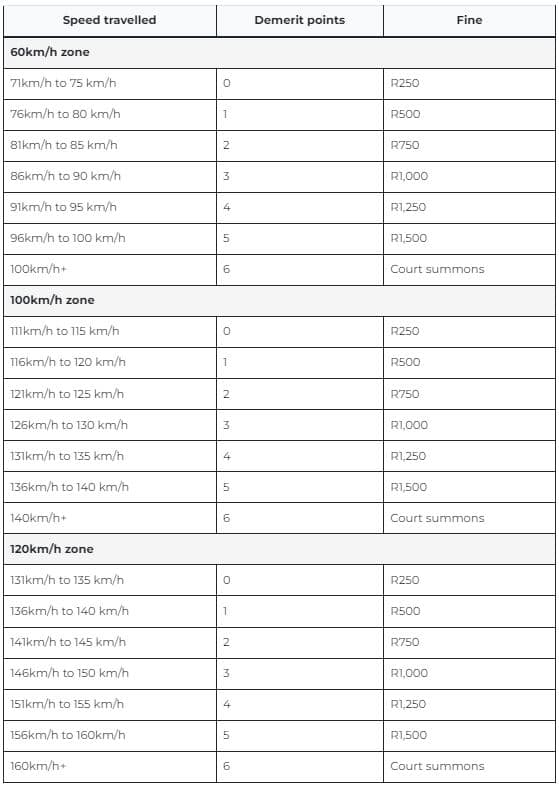
Source: Department of Transport, Organisation Undoing Tax Abuse (OUTA)